
Kindergarten readiness rarely comes down to whether a child can recite the alphabet. You see it in smaller moments: a four-year-old hanging up her own backpack, waiting for a turn at the block table, or raising a hand to share an idea with the group. If you are comparing options for a Pre-K academy in Marietta, GA, those everyday moments tell you a lot.
A strong Pre-K year blends early academics with something harder to measure: confidence. Children who feel secure in their routines and capable in their classroom tend to walk into kindergarten ready to learn, not just ready to sit still.
This guide is for parents who want a real picture of what a strong Pre-K year looks like. We will cover the skills that matter most before kindergarten, how the K Prep program at Macland Pointe supports that growth, and what to look for when you visit.
What a Pre-K Academy Should Actually Do
Here is something kindergarten teachers will tell you: the children who struggle are not always the ones who do not know their letters. More often, it is children who have not had enough practice managing transitions, solving small problems, or simply waiting their turn.
A good Pre-K year builds all of that. Literacy, yes. Math concepts, yes. But also the social and emotional piece: how to wait, how to handle frustration, how to try something you are not sure you can do yet. And independence. Real, practical independence that shows up in small moments throughout the day.
When those pieces are woven into a calm, organized day, children thrive. When any one of them is missing, something gets lost. The best programs hold it all together and make it feel natural.
Inside K Prep Preschool Marietta: What the Day Actually Looks Like
K Prep at Macland Pointe is built on a straightforward foundation. Children do better when they feel safe, know what is coming, and have room to explore. Everything in the classroom builds from that.
Routines That Do the Heavy Lifting
There is a reason strong programs keep their schedules consistent, even on difficult days. When the routine is predictable, children stop spending energy on figuring out what comes next and start spending it on learning. They arrive, they know what to do, and they move through the day with confidence.
Transitions are where many classrooms fall apart. Going from circle time to learning centers to outdoor play sounds simple, but it is where anxious children get overwhelmed and distracted children drift. A calm signal, a clear instruction, a consistent sequence. These are not small details. They are exactly what a kindergarten classroom will expect.
Learning That Stays With Them
Four- and five-year-olds learn by doing. Counting real objects instead of filling in a worksheet. Acting out a story instead of just hearing it. Building something, watching it fall, and figuring out what went wrong. Hands-on learning is not a buzzword here. It is how this age group actually holds on to new ideas.
The persistence that comes from those moments matters, too. A child who rebuilds a tower after it falls, or flips a puzzle piece and tries a different angle, is practicing something that shows up later.
Teachers Who Know When to Step Back
There is a difference between a teacher who manages a classroom and one who genuinely guides children. The best Pre-K teachers do both. They hold clear expectations and keep things calm, but they also watch for the moments when a child needs a gentle nudge versus a little more time. They do not hover. They check in.
That kind of steady presence builds trust. Children who trust their teachers are more willing to take risks, ask questions, and try things they are not sure about yet.
The Skills Behind Kindergarten Readiness Marietta, GA Parents Should Know
There is no single skill that makes a child ready for kindergarten. It is always a combination, and each piece supports the others.
Early Literacy
The goal in Pre-K is not to have every child reading by spring. It is to build a relationship with language. Listening closely, noticing sounds, recognizing letters, connecting words on a page to words they already know how to say. That foundation makes everything that comes after much easier.
Classroom conversations matter here as much as structured lessons. A room that talks, really talks, builds vocabulary and comprehension in ways that show up years down the road.
Number Sense
Counting to twenty is the surface. Underneath it is understanding. Does five feel like more than three? Can a child spot a pattern and predict what comes next? Can they sort, compare, and estimate? These are not abstract concepts when you are scooping sand, sorting buttons, or dividing snacks. They are just part of Tuesday.
Social-Emotional Skills
This is the category parents sometimes underestimate. Sharing. Waiting. Using words instead of hands when something goes wrong. Recovering when things do not go as planned. These are learned skills that take a lot of practice. A good Pre-K classroom gives children that practice in low-stakes moments, with a patient adult nearby, so that by kindergarten it is not all brand new.
Independence
Putting on a jacket and cleaning up a workspace. Choosing an activity and following through with it. Opening a lunch box. These seem small, but they matter enormously, both for a child’s confidence and for their ability to function in a kindergarten classroom. Every time a child manages something on their own, they become a little more certain they can do it.
How Confidence Grows Over the Course of the Year
Confidence does not come from praise alone. It comes from doing things repeatedly in a safe, organized place.
A child who spends a year in a structured Pre-K classroom, where routines are predictable and teachers are calm and consistent, builds up a quiet confidence that carries forward. They have practiced. They have handled things going sideways. They have figured things out on their own.
You see it in small ways as the year progresses. The child who used to freeze during transitions starts moving through them without a second thought. The one who struggled in group time learns to wait before speaking. It is not a dramatic shift. It is steady, cumulative growth. And that is exactly what the kindergarten year needs to be built on.
What to Look for on a Pre-K Tour
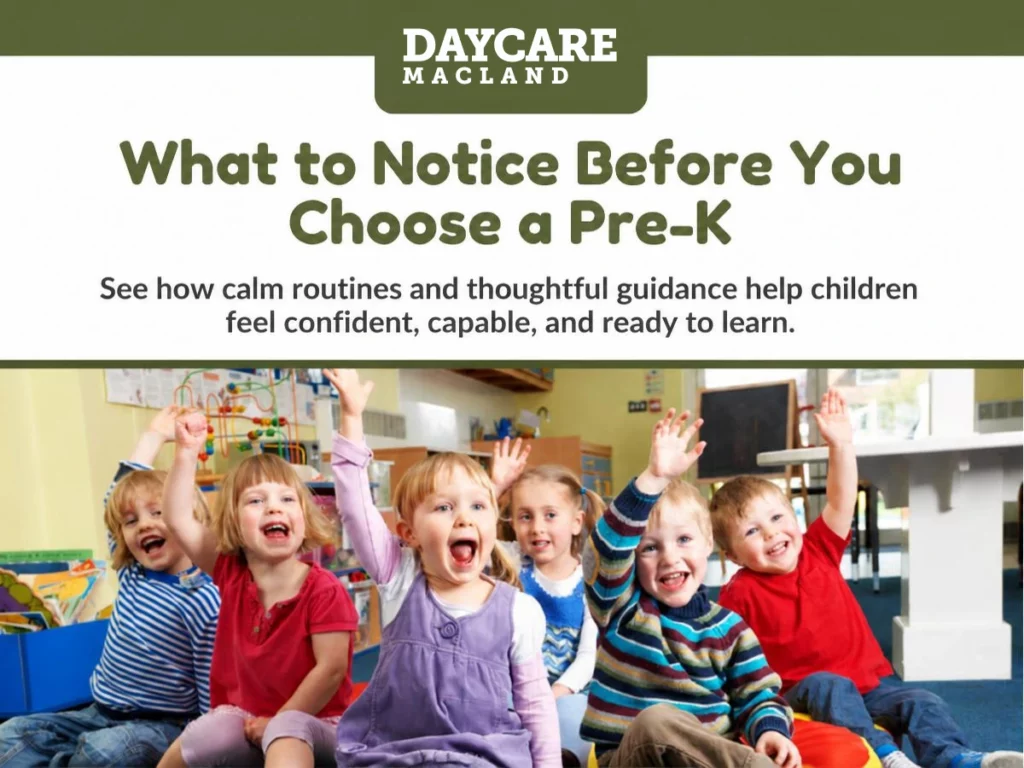
Walk in and give yourself a few minutes before you look at any materials. The classroom will tell you more than a brochure will. A strong program does not need to announce itself. You can usually sense it in the first five minutes: the room feels calm, the day has a rhythm, and adults move with purpose.
Here is a practical checklist to keep your visits consistent:
- A calm, organized room. Materials have a place and children seem to know where things go.
- Smooth transitions. Watch how the class moves from one activity to the next. Calm and predictable is a good sign.
- Engaged children. Look for kids who are busy with purpose, not wandering or waiting with nothing to do.
- How teachers talk to children. Especially when someone is upset. That tone tells you a great deal.
- Secure entry and pickup. Check-in and dismissal steps should be clear and followed every time, even when it is busy.
- Outdoor time built into the day. It should be scheduled, supervised, and treated like a real part of learning, not just a break between activities.
Bring your own questions too. Ask how the program communicates with families, how teachers support a child who needs more time with a skill, and what they look for when a child is ready to move on.
See What A Calm, Structured Day Can Feel Like
Sometimes the clearest way to compare Pre-K options is to see the classroom for yourself. A tour gives you a chance to notice the rhythm of the day, how teachers guide transitions, and how children move through activities with confidence.
Ready to learn more about Pre-K in Macland Pointe? Book a Tour to take the next step, or call (470) 523-7867 if you have questions and want to learn more.